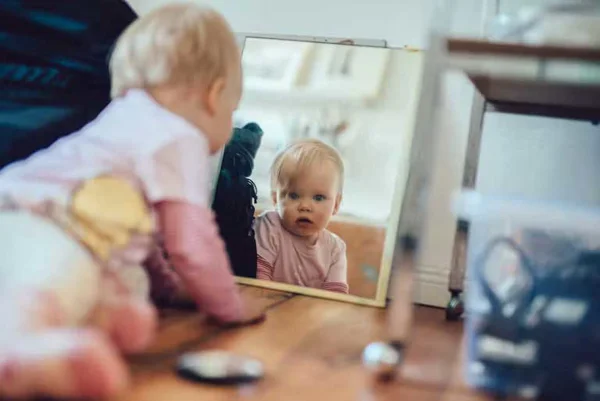

 ## Are Your Babies Recognizing Their Own Reflections?
There are many small experiments that parents can do at home to track the development of their baby's self-awareness. When your four-month-old baby is held about a baby's arm's length away from a mirror, and your spouse or friend brings a toy closer to the baby so that the baby can clearly see the toy,
Ask questions like, "Where is the toy? Can you see it?" to encourage the baby to react to what it is looking at. As a general response, the baby will tend to reach towards the reflection of its own face in the mirror, rather than towards the toy. Once you see this, try to make a sound with the toy. The baby will turn its head back to look at the toy.
Put the toy away, then make the baby interested in the mirror again, and then slowly bring the toy back into view. This "hide-and-seek" game can be very fun for everyone. Through this game, you can not only track your baby's development, but also play an active role in its learning process.
#Advertising
## Baby Mirror Experiments and Red Dot Game According to MonthsFor the next four months, observe how your baby communicates with its own reflection by smiling and making faces in the mirror. This can be very fun. Play "peek-a-boo" with the baby in the mirror, talk to the baby while it is looking at its reflection, or let it quietly observe its own face. When your baby is ten months old, repeat the toy experiment. This time, you will see that the baby tries to find the toy by turning its head.
When your baby is one year old, you can play the "red dot game". Use something that is easy to remove, such as a lipstick, and gently dab it on the baby's forehead or the tip of its nose. It is not appropriate to stick a sticker, because the baby may feel the presence of the sticker before looking at the mirror.
After applying the red dot, give the baby some time to get used to it before looking at the mirror, so that the baby cannot directly associate the two. Is the baby pointing at the dot in the mirror, or is it trying to wipe it off? Try to understand the baby's reaction. Another variation of this game is to measure how well the baby remembers your face. Put a red dot on the baby's nose without it seeing, and then ask the baby, "What's this?"
#Advertising
## 25 Tips to Support Your Baby's DevelopmentYes, children learn many things just by watching you, but you can also help them develop more easily.
1. Talk to them.
Talking to and listening to your children is the two most important things you can do. If no one talks to them, they will not learn to communicate, and if no one listens to them, they will not be able to practice their communication skills. Talk to your child throughout its life, as it needs to communicate with you in every stage of its development! According to research, the way you talk to your baby is different from other people, and the baby will learn to communicate by listening to your words. Your loving words are beneficial for the baby's brain development.
2. Sing to them.
Singing songs and making funny noises with your baby will help it to speak earlier.
3. Name objects.
Name objects and describe them to your baby, compare objects with each other, and explain what they are used for. You will see that your baby is listening attentively!
4. Eliminate background noise.
If the TV or radio is too loud, it will interfere with both your and your baby's listening and speaking activities.
#Advertising
5. Pay full attention to your child when it is talking.
Try not to turn your back, and make eye contact while you are talking to your child.
6. Read to them.
Reading to your child helps it to learn language, expands its perception and attention. So, make books a part of your life, and always read to your child before it falls asleep. When your child starts to show interest, read to it while pointing to the letters and shapes, so that some children can learn to read from the age of 3.
7. Play music.
While it is not proven that classical music makes children smarter, music will enrich your child's mental and emotional development. Some people believe that there is a connection between music and mathematical ability. However, studies have shown that musicians are not necessarily better at math than other people. Early learning of mathematics by children is more important than the family's support and learning through books and communication.
8. Sing to your child while it is sleeping.
This will help your child to fall asleep more easily, and also to expand its vocabulary.
9. Teach other things while playing music.
"One, two, three, here comes the trash, four, five, six, time to brush your teeth" like.
10. Let your child choose the music.
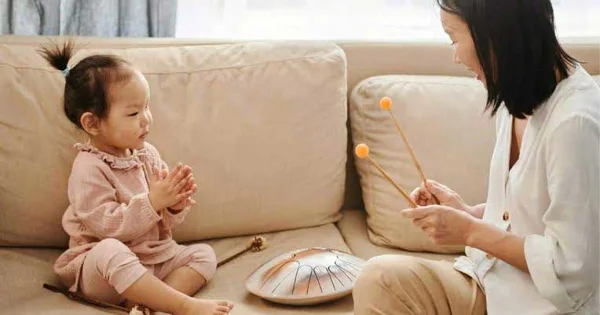
Let your child listen to different types of music, including drums, bells, and other instruments.
11. Let your child paint.
Don't prevent your child from painting and playing with clay, as these activities will help to develop its fine motor skills and allow it to express itself creatively.
#Advertising
12. Praise your child's efforts.
Praise your child for its efforts, and display its work in a place where everyone can see it.
13. Provide art supplies.
Provide your child with art supplies, such as egg cartons, plastic bags, toilet paper rolls, and construction paper. You can also use old magazines and newspapers to create collages for your child.
14. Teach numbers in a simple way.
Teach your child numbers in a simple way, such as "One, two, three, how many fingers do you have?" "Which is bigger, one or two?"
15. Use numbers in songs.
"Five, six, seven, what comes after seven?" like.
16. Teach quantity.
You can start teaching your child about quantity by asking questions like "Which one is bigger?" or "Which one is smaller?"
17. Use toys and games to teach numbers.
Use magnetic number toys, number blocks, or number puzzles.
18. Teach numbers by breaking things into pieces.
Break food into small pieces and have your child count them.
19. Never use a baby as a TV babysitter.
Because your baby needs your attention and interaction to learn and develop.
20. Repetition is good for learning.
Repetition helps your baby to learn.
21. Go on outings and learn.
Taking your baby on outings to parks, libraries, or museums will help it to learn and explore.
22. Vary your activities.
Take your child to different places and activities to expose it to new experiences.
23. Utilize public resources.
Take your child to parks, libraries, museums, art galleries, and swimming pools to socialize.
24. Use mirrors.
Let your baby look at its reflection in the mirror to develop its sense of self and body awareness.
25. Breastfeed your baby.
Breastfeed your baby for at least six months.