

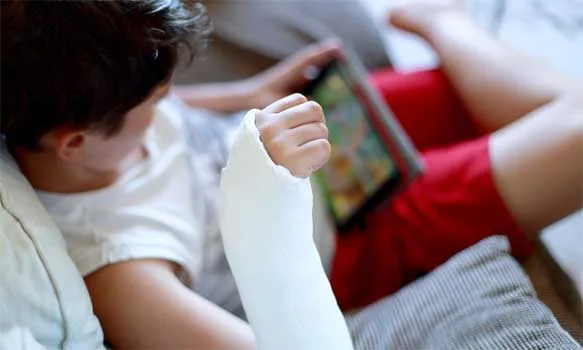

Ç the endless energy of children, their unbridled movements, their running and playing, causes fractures to occur at times in hands, wrists, legs, or fingers.
Bone fractures that were not properly treated and were not treated at the time and have a negative impact on the children's development and development. Orthopedi and Traumatology Expert Doç Dr. Hakan Özoy, çfrases and treatments in the children gave information about their environments. ;

Ç the ones that parents need to know about in the treatment of broken children.
- Ç Children's luck is flexible bones
Different bone fractures in each age group are görür¸ bones are like a fresh web; bones are like a branch. The size ç the size ç the shape of the hand is bowing down and the size of the elbow; the shape of the bones are broken; the shape of the legs are broken; the shape of the legs are broken; the shape of the legs are broken; the shape of the shape of the legs. Ç the shape of the bones are not broken. Ç the shape of the shape of the body and the shape of the body is broken.
#Reclalm
- Fast boil ç in childhood, m&mk&m;mm&m;
Each fracture is different from the other. The period of the bone that surrounds the bone is thicker in the form, and the bone is more thick in the form and it helps to boil the bone. Ç in those years, the fractures of the wrist are healing in 3-4 weeks while the fractures are increasing in three or four weeks, and this s¨ is at an advanced age; up to 4-6 weeks. We have advanced. The age is increasing. The boiling of the broken bone is extended.
- Watch your feeding!
Çformation çin the fractures in the skin g¨in a glass of one or two glasses of s&supl;int ¨in ¨i¨i<i>in the rapid boiling of the fracture;in the rapid boiling of the fracture;in the calcium deposits;in the calcium;in the pecium deposits çin çin from their ar epologetic;in çin de &clus;in &clus;in &dil;i<i<i>i>in is a dyluml>Theord.
Ç due to the fractures with the mass, v&UMl;cudın çObjable;Stuffable in situations in which the energy is needed. Both legs and arms are broken, or çStuffs need to be more careful of their diet.

- özg&um; treatment for fracture structure
Each fracture has different treatments, yönethems. Some are treated with alç some with surgery. If there is no boiling in an arm fracture or a faulty boil, then it must be operated on, supported by screws and wires.
#Reclamation
- Ç how do you differentiate from adults?
Ç broken treatment in children is similar to that of adults; basic butç providing the bone to heal in normal position. ç children have the ability to improve and reshape from the outside, but they can be treated differently from the outside by being able to fix the bone by taking the body and support.
Some fractures require that the bones be replaced in a more normal position (which is called re-subliml;içiçi, or atel içi;i, e.g., e. g., e., e., e., e., e., "re-re-re-re-re-re-im-action"); and that the children need to stabilize the bones, because of their bone capacity for recovery;i.e., or because of their bone bones, the possibility of hearing is more likely to be performed to be replaced by adult g&olumluml;re;re;re;i.e.e.e.e., and so because of their bone recovery, and because of their ability to be fixed, and because of their ability to be more likely to be fixed, and more likely to be broken.e.e.e.e.e.e.e.e.e.e.e.e.e.e.e.e.e.e.e.e.e.e.e.e.e.e.e.e.e.e.e.e.e.e.e.e.e.e.e.e.e.e.e.e.e.e.e.e.
- Ç Avoiding surgery on the child; to be drawn can affect his life;
Ç children çok mobile and active; simple fractures çoccadil;occadil;simple fractures are often made. These fractures are easy to boil. çfor the dislocated elbow fractures are &ccellable;the fractures require surgery çthe key is to make the patient long s&juml;re alçand the disease is easy to detect with the iccedilable;the iccedil;the tissues and the vida;the fluids are very easy to find.
Families ç içrestraint from having their children operated; some permanent damage is being done after the fractures. The fractures ço is boiling fast and are not heard in serious physical therapy. In broken treatment, but in a moment &oluml; when you have a patient, you need to restore to normal life.
- Ç Helping heal my son's fracture; what can I do?
The broken bone ç the children ç the sons; the sons; the sons ç the long-term effects of their fractures improve quickly; they do not live.
The string below can help to heal bones and health:
The first 3-7 gürestrain the swelling and the infection during the period i&bsp;in&bsp;and apply the ice and keep the broken böhold the Ige at the height.
- Balanced Feed Ömemple
Ç Help your child feed on a balanced and nutritious diet. Calcium and vitamin D, bone health için &oluml;especially öneutral nutrients.
Stop smoking/t&t&um;n use. Nicotine prevents recovery. Passive iç ç which is exposed to accedil; in those cases, the risk of developing bones not healing is much more likely to be poor.
Ç Follow your child's activity and encourage your doctor to comply with his options regarding activity restrictions.
Pain usually comes before the fracture is fully healed;ok öeceml;ece gçer. No pain means they're ready to go back to full activity.
- How much does the broken healing cost?
Ç most simple fractures heal in six weeks iç more often better; more often, the fractures can improve in less s&ccell; more quickly; more serious fractures, &oluml; more likely joints and b&huml; the replacement plates are better; the full recovery is better; the more likely the more likely the bones can be restored; the more satisfying the number of the changes are a good way to be done; and the more satisfying the number of the changes that are performed, the more accurate the more likely to be done.
- What symptoms do I need more medical attention?
Ç your child has severe, increasing pain and swelling, and this pain and swelling is not applied to ice, yü keep it in the air and be able to keep it in the air and with the prosciuttos your doctor has requested.
Ç your child has increasing tension, numbness, tingling or burning sensations in his injured limb or having trouble moving his fingers or toes under his arm.
Ç there are signs of blood loss in the limbs injured in your child: fingers and toes pale, blue, blue; nah; nah; nah; nah; nah; nah; nah, nah, nah, nah, nah, nah, nah, nah.
Ç If your child feels severe pain from a blow to a body or injured limb or hears something "slooping" or "moving," or "moving," let us know.
Ç another aç such as the flu or the flu; without a stroke, fever or tremors develop.









