

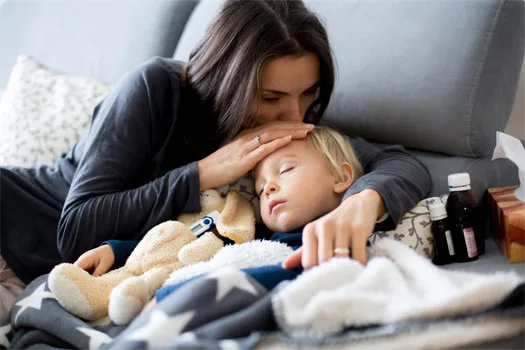

ÇIs your son sick? <i>Is he sick? <i>You can find out what you can do about repeated colds, ear infections, sore throats, zatüi>and what you can do about repeated diseases.
Ç One of the most common reasons for applying to the local health clinics is that parents worry that their children are often sick. ÇObviously, their families are concerned, but in fact, half of the children are considered completely healthy. We have been.&cced;a&cceml;&ccell;>In some ways, there is imm&musl;n;n (communition) failure or chronic illness.
Ç Child Health and Diseases Expert Dr. Anil Doğan Bektaş, frequently ill ç &olum; shared information on approach to children.

ÇS<i>The fact that families who have often been ill have been asked to consult the doctor çi>know that they have child diseases is known çi>mmm;i>Imaginary.
|
What Should I do with Repeating Diseases? |
1. Ç Kaç a Year; Normal for Once Sick?
- Ç 10-12 times a year ÜSYE ge&cced;Can
Ç mostly under 5 years of age, is ç, who goes to day care or to school or to school; in the children, respiratory infections can be introduced 10-12 times a year. ¨st is an average 7-15 g&s;and the average is the same as the average shouml;d&hum;mul;mul;mul;mul;mul;mul;mul;mul;mul;mul;mul;mul;mults of airway infections can be introduced 10-12 times a year. &s;mult airway infection;/s are accepted in an average of the year;mult respiratory infection;m/s must be accepted as a half of the year;mult (s);mult patient;/s;/s;/st.
2. Ç your child's immune system G<i>m<i>?
- Immune failure must be investigated
More than 3&rsquo, more than 3&squo per year, more than 3&squo; infections such as auto, sinüzite, bronchiolitis, bronchiitis, and other factors that are common to be infected with, more than two months of infections, and the use of re-intended antibiotics, an unexpected complication, and the ccedil; are often sought to explore immune failure in patients who are not qualified to be treated from feet and mouth.
ç, which is often sick; you need to know about children
- ç, which goes to kindergarten and kindergarten, is &olum;ispecially the first two years of infection, and we are the most frequent introductions.
- Passive cigarettes için turn, respiratory pathways increase the risk of infection.
- Children can be exposed to a low-five-year-old ç 5-6 times &huml; a respiratory infection.
- Healthy ç children, usually in the first 3 years of their lives, are seriously infected except for one pnömoni (zat&rre) and 2 otitis media (centre ear infection)
- They don't; they have good responses to treatment and they're normally monitored.
- ç, which has repeated infections, has a low-level allergic structure, so it is chronically allergic ridinite (saman flu), ç children are accidentally recurred &huml;st respiratory infection.
- However, the children are more prone to allergic and long s&humdil; they are more likely to be respiratory infections, this ç and the children are also b&huml;mol;m/m/s&m;m/s;m/s&m; and they are normal to develop and develop.
- This ç in children it may be an allergic sub-structure; in children &olum; in children it may be a horizontal ç in terms of wiping the nose with a continuous hand; in terms of the language.
- ç, which is allergic to the underlying subset, is also known as IgE d&huml;its features can be detected if they are missing; they are often allergic to family.
- ç, which is allergic; immunocompulsive in children with allergies, can be.
- ç, which is often ill, also has a chronic disease in 10% of children, and the children's development is also very much behind their peers.
- The imm¨n) immuneness (imm&dil;children, often sick çm&squo;forms about 10% of children;forms of infections that require hospital resolving;y&m&mul;m&m/imm;formation growth-resistant presence, early &oluml;m&m;m&m;m&m;m&m;resistant infections that require treatment;m&m/m/im/im/m/m/m/m/m/m/m/m/m/m/m/m/m/m/m/m/m/m/m/m/m/m/m/m/m/m/m/m/m/m/m/m/m/m/m/m/m/m/m/m/m/m/m/m/m/m/m/m/m/m/m/m/m/m/m/m/m/m/m/m/m/m/m/m/f/f/f;f;f;f;f;f;f;f;f;f;f;f;f;f;f;f;f;f;f;f;f;f;f;f;f;f;f;f;f;f;f;l;l;f;f;l;l;l;l;l;l;l;l;l;l;l;l;l;l;l;l;l;l;l;l;l;l;l;l;l;l;l;l;l;l;l;l;l;l;l;l;l;l;l;l;l;l;l;l;l;l;l;l;l;l;l;l;l;l&D;l;l;l;l;l;l;l;l;l;l;l;l;l;l;l;l;l&D;l&/l;l;l;l;l;l;l;l;l;l;l;l;l;l&l&D;l;l;l;l;l;
- ç, a frequent illness complaint; a detailed ö and physical examination is the most valuable diagnostic tool to distinguish whether it is a common illness or a normal condition.
- The age of illness, frequency, which böthe details of the infection are both specific and essential; çok öa place of content in determining whether the factor is really immune;a well known as the infection.
- ÇPediatrics doctor who evaluates the child, then determines whether his cells are within normal limits, whether they are allergic or not. After that, he decides to examine the children further.
- ÇTo reduce the frequency of infections in children and to help them overcome infections more easily;in, çtheir children are m&hum;mulum;we are not able to be able to protect them from airless and crowded environments;to keep passive cigarettes from their use;to be careful of their balanced diet and adequate sleep;to be able to take care of their allergic sleep;to be able to be able to be able to take care of their allergies;to be able to keep them out of their own airless and crowded environments;to be able to keep them from their passive cigarettes;to be able to be able to sleep.
- ç, which is immune, is also a form of diagnostics that are timeless and are also essential to the child's protection against severe infections.
- Ç children should be kept away from packed foods, kept away from life without moving, provided proper psychological environments and avoided frequent antibiotics;









