


#Advertising
Expert Advice on Critical Issues
For parents, the development of language and speech is a major concern. However, common misconceptions about children can delay the timely receipt of expert support.
Speech Language Therapist Dr. Ög. Üyesi Seçil Aydın Oral, discusses the most common questions and concerns of parents, practical methods that can be applied in daily life, and the importance of early intervention.
Here are the answers to the most common questions and expert advice:
1. Is the belief that "boys are late talkers" correct?
No, it is not correct. Among parents, the belief that "boys are late talkers" is very common. While there may be a slightly higher risk of late speech in boys scientifically, this does not mean that the child will definitely not reach the age of their peers. A significant portion of the language skills developed in preschool years continue into school age. Therefore, gender should never be a reason to delay evaluation.
2. Can the fact that "my father also spoke late" be considered?
Absolutely not. Having a family history of late speech does not normalize the situation; it actually indicates an increased risk. Approaches such as "When the child starts kindergarten, they will start speaking" or "Language will eventually come" are not supported by scientific evidence. School age is often too late for language intervention.
#Advertising
When to Seek Help for Speech Delay in Children?
3. Can the cause of speech delay be "language disorder"?
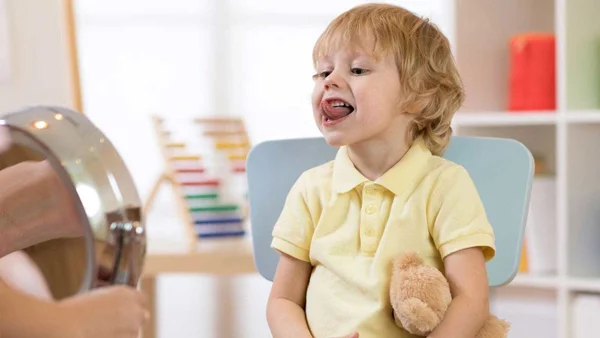
Language disorder is a structural difference that can only limit the movement of the tongue. It is most common in babies who are fed with breast milk. Scientifically, there is no strong evidence that language disorder directly affects the ability to learn words or form sentences. Therefore, attributing the cause of speech delay to language disorder is incorrect.
4. What signs should be immediately evaluated?
Dr. Seçil Aydın Oral emphasizes that if any of the following signs are observed, a Speech Language Therapist should be consulted immediately:
- Not responding to his name at 1 year old,
- Not responding to sounds or making eye contact at 1 year old,
- Not using any words at 1.5 years old.
Remember: Language development is not just about the number of words a child says; the child's ability to understand what is said and their interest in communicating and interacting with others are also critical.
#Advertising
5. Is it normal for a child to understand but not speak?
Good understanding skills are a positive sign for future speech success; however, this does not mean that there is no problem. Some children who are late talkers also have difficulty understanding sentences, which can be a sign of a permanent language problem. Therefore, understanding skills should also be assessed by experts.
6. Does a child who uses gestures to communicate have a speech delay?
Using gestures or signs to communicate is a positive step in communication. However, gestures do not replace speech. Gestures should be supported and combined with speech. If a child has never spoken, it should be evaluated.
7. Does screen time delay speech?
Watching television or videos can displace the opportunities for interaction between parents and children. For example, having the television on constantly during meals is a significant risk factor. Even if the child is watching television, it should be done together and discussed afterwards.
8. Does bilingualism cause speech delay?
When evaluating the language skills of bilingual children, the number of words they know in both languages should be considered. Bilingual children do not lag behind their monolingual peers when both languages are considered together. Bilingualism should not be considered as a reason for speech delay.
#Advertising

How Parents Can Support Their Child's Language Development in Daily Life
The following strategies that parents can apply in their homes are supported by science:
- Describe what the child is doing in words: "Now you are putting the car in the box"
- Wait for a response: After asking a question or initiating interaction, wait and give the child time to respond.
- Expand on what the child says: "Yes, that's a red car"
- Read books together: Read picture books together every day, pointing out the pictures and talking about them.









