

Artistic Activities & Benefits for Children
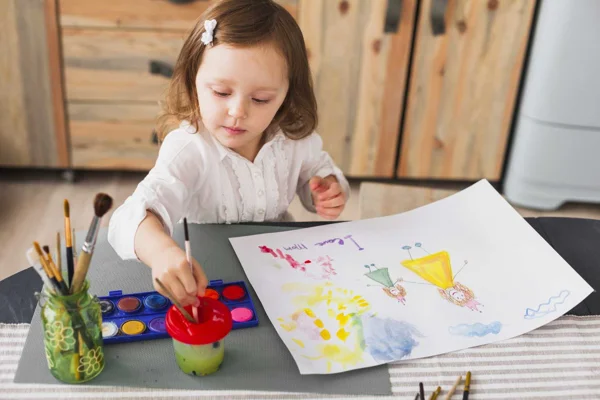
Artist Faika Shafak emphasizes that children's free artistic activities support their imagination and creativity, and that families may experience "messy house" concerns when their children engage in these activities. Shafak encourages parents to reassure their children that it is "not important," that it can be cleaned up, and that their work is more important.
Benefits of Art Activities for Children
Artist Faika Shafak lists the benefits of art activities for children as follows:
- Supports mental development.
- Learn colors, shapes, etc.
- Hand-eye coordination develops.
- Increases self-confidence.
- Enhances social-emotional development.
- Develops imagination.
- Learn to identify and use materials.
When children engage in art activities, they also experience feelings of freedom, curiosity, and adventure. It is impossible to expect children to experience these feelings again if their interests and desires are suppressed.
The Scribbling Phase and Parental Approach
Artist Faika Shafak emphasizes that every activity that children do with their hands is very important for strengthening their finger muscles. Shafak also states that the scribbling phase is also very important for children. Shafak suggests that parents provide a wide area for their children to scribble from a young age, and that they model for them by placing a variety of colorful pastels and colored pencils in front of them.
This allows children to prepare for reading and writing activities. If possible, parents can paint the walls of the living room or their child's room with thick drawing cardboard so that their children can reach them, which will provide their children with many enjoyable moments. There are some factors that parents can use to increase their children's independence and self-confidence.
Parents should explain to their children why and how the limitations are being imposed. Parents should try to gain the trust of their children by letting them know that they trust them. It is very important to respect and validate children's communication.
Parents can get to know their children better and improve their communication by observing them. The most important thing is the process, not the product. Sometimes, families discourage their children by criticizing and scolding them for their work. Instead, parents should praise their children's work and display it in a suitable place.