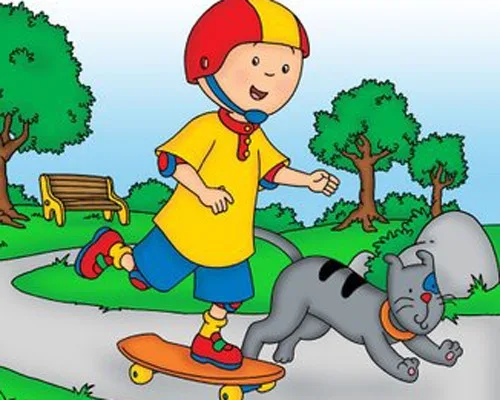


Why shouldn't you let your child watch Caillou (Kayu)?
Especially for preschool children, who watch a cartoon character named Kayu (or originally Caillou) with a huge passion; from their toys to their clothes, they buy everything related to this character. Kayu is a phenomenon in the world, especially among preschool children aged 2-6 years.
The cartoon film, "Caillou," has a certain effect on children. Kayu has created a market. Everything related to Kayu is sold everywhere, and children are obsessed with buying them, they even have crying fits.
Psychologist and Pedagog Sevil Yavuz, who specializes in child and adolescent psychology, explains the negative effects of Kayu on children. She says that many parents complain about their children being obsessed with Kayu.
What a Mother Noticed...
Experts say that the question of how a cartoon character like Kayu becomes an idol for children, especially at a young age, can be answered by Kayu's daily life and simplicity.
A mother shares her observations about what she has noticed about her daughter:
"1. My daughter, who is not yet afraid of the dark, saw the episode about Kayu being afraid of the dark and learned what fear is, and she started asking us to take her to her room.
My friend, whose daughter is older, told me that after watching a part about aging and death, her daughter started asking her mother when she would get old and die. She had emotional scenes with her father, asking him not to get old and not to die.
My daughter, who goes to kindergarten, started crying a few days after she started crying. One day, she surprised me by saying, "Mom, I don't want to be embarrassed anymore," after seeing the part where Kayu's big brother met his friend and said, "Kayu's big brother was a little embarrassed." This was the same question I had asked her before, but I hadn't really focused on it at the time.
So far, these are our Kayu adventures, but I'm wondering how children perceive these messages. Is it just my daughter who is experiencing this, or are all children experiencing it?
Parents are Concerned
I completely agree with my wife's concerns. All children seem to perceive these messages in this way. Kayu has become an idol for young children. Everything that this character does is considered right for children at this age. Children learn from this character, who is like them.
That's why I decided to write about this issue, as there is a lot of demand from parents. After carefully watching and analyzing a few episodes of Kayu, both in Turkish and in the original English, I want to point out the first negative aspects I noticed.
What are the Negative Aspects of Kayu?
The first thing I noticed in the cartoon was the cultural differences. The child is constantly thanking his parents. "Thank you" is translated directly from Turkish as "sağol," which is a more familiar word, unlike our culture where we don't thank people for everything.
Kayu is Teaching Children a Different Culture!
Our emotional bond is based on gratitude. Gratitude is a sign of respect and distance. Expressing gratitude to a child can create a distance between the child and the parents. In our culture, the emotional bond is very strong, and we are not an individualistic society.
Kayu Asks His Parents for Permission to Even Take a Breath
Also, in our culture, our children don't ask their parents for permission to do anything, they act independently. Kayu asks his parents for permission to even take a breath, everything is for gratitude.
An Overly Polite Child: Kayu
In this form, Kayu is an overly polite child. We don't think he's a child, but rather a grown-up. Actually, our children model themselves on this child character. This is not healthy, because we want our children to be children, to behave like children, and to enjoy their childhood.
Kayu is Causing Egocentrism in Children!
The cartoon features a core family of four, but everything revolves around Kayu. The other family members and the other child are in the background. The other child is just a prop in the film. The other child is there to make Kayu happy. This is clearly visible in the film. The film is like a fairy tale book. Everything except Kayu and the characters in the book are static and simple.
Kayu's Most Demanding Requests Are Accommodated...
The family is not a place where endless happiness exists, but it is the smallest building block of society. Just like in society, there can be disagreements in the family. Children develop problem-solving skills in the family before they enter society. But Kayu's parents are so happy that everything always goes well. Or rather, they are trying to make Kayu happy.
Problems in the family are solved in a way that Kayu will be happy, and this is not realistic. The child never experiences disappointment or rejection. Kayu's most outrageous requests are always accommodated. The parents are always calm and never get angry.
The World Revolves Around Kayu!
In the cartoon, everything is pink and perfect. If the cartoon doesn't start with a child's daily life, there's nothing wrong with it. But if it's based on reality, it should reflect real life. If it's a fantasy, children will gradually understand that it's not real. But this cartoon claims to be real, so it's dangerous for children. Children can compare their parents to Kayu's parents and criticize them. For example, a child can say to their mother, "Mom, Kayu's mom lets him go outside in the cold, but you don't let me."
Kayu is Making Children Passive!
In Kayu, the child's life is so slow and boring that everything that the child does is narrated by a voice in the background. The child doesn't have the opportunity to build relationships. For example, in the scene where "Kayu picks up a ball and smiles," the voice in the background says, "Kayu likes to hold a ball."
In our culture, children are active and can understand things without being told. By watching this cartoon, we are actually hindering our children's mental development.
Kayu's drawing is also very bad. Kayu is like a puppet in the cartoon. Kayu is drawn like a baby, and his gestures and expressions are not understood, so a voice in the background narrates the child's emotions. When I watch Kayu, I don't feel like I'm watching a cartoon, I feel like I'm turning the pages of a fairy tale book.
Kayu Doesn't Have Any Educational Value, Except for Commercial Value!
I haven't found any educational value in the episodes of Kayu that I've watched. Our children learn by experiencing their daily lives. They don't need to learn from watching it. The only negative aspect of this cartoon is that it provides a bad example. For example, in the episode where Kayu has breakfast, everything is made a big deal out of. The parents are always watching Kayu, and the other child is in the background. Kayu's helicopter parents are a good example. The themes in the cartoon are completely unrealistic and harmful to children.
In addition, children keep asking for Kayu accessories and toys. The market for Kayu is created. Everything related to Kayu is sold everywhere, and children are obsessed with buying them.
I've only noticed these negative aspects after watching a few episodes. Each episode has different themes, and each theme needs to be analyzed separately.
My suggestion to parents is to limit their children's exposure to Kayu. If they do, their children will become obsessed with Kayu.
Please limit your children's exposure to Kayu.